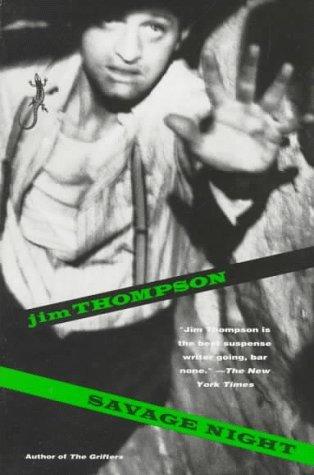
Thompson, J. (1991). Savage Night. Vintage Books.
Doubles, delusions, and despair abound in this compact, punchy noir. Our dubious narrator, erstwhile hit-man Charles “Little” Bigger, is back at work, compelled by a shadowy mafioso known only as “The Man” to dispose of a former bookie-turned states’ witness. Standing 5 ft tall and overcome with consumption, Charlie struts through Savage Night with lifts in his shoes, false teeth, a new identity, and a naive confidence that he’s got this job in the bag. But living multiple lives takes its’ toll, especially with a past as storied as Charlie’s. From this initial deception emerges a mystifying stew of identities—lost, mistaken, disputed… Oscillating between a murderer’s insecure ramblings, existential reveries, and lusty liaisons, the suspense of Savage Night flows from author Jim Thompson’s chaotic, experimental, and shifty narration. In normalizing violence and ambiguous morality, the story in Savage Night swivels around a cruel, yawning void, luring readers into chilling compliance.
In my mind’s eye, the “adrenaline” genres—mainly thriller and suspense—invoke black and white, film-informed images: the sleazy lounge-lizards, corrupt detectives, femme fatales, and otherwise shady figures of American noir. I decided on Savage Night (originally published in 1953) for this week’s book to both interrogate and satisfy these impressions. Of course, these ideas represent only a very narrow and perhaps stereotypical sub-section of the crime genre, itself a sub-section of thriller or suspense. After reading Savage Night, I wondered about what differentiates genre from stereotypes. Are the iconic, sometimes antiquated tropes and visual symbols of noir what define it as a genre? Mackintosh and Alonso Alonso discuss “noir aesthetics” as more of a narrative style and approach towards criminality that emphasizes moral ambiguity, identifies the reader with unreliable protagonists, and draws readers into a perpetually, systemically disordered world (2020). In my research I found that the generic stereotypes associated with literary noir can both normalize “traditional”values and provide a structure through which to protest them. Beyond American noir fiction, noir aesthetics are present across a wide range of literary traditions, wherein place-specific cultural and political tensions further refract the boundaries of the genre (Mackintosh & Alonso Alonso, 2020).
I also wondered: How does cinema factor in to the appeal of crime and noir genres for readers, or other genres for that matter? I did a little bit of research to try and determine the boundaries and origins of noir; what I found was that the term is relatively new and primarily advanced by critics (Neale, 2000). Noir fiction does predate film noir, and the proliferation of Hollywood adaptations of noir fiction is probably the source of my mentally merging the two. These pre-existing relationships between noir fiction and film present a potential promotional idea for the library, wherein both films and novels in the catalogue—adaptations and stand-alone works—could be featured in recommendation lists or in themed displays.
Mackintosh, F., & Alonso Alonso, M. (2020). Introduction: Noir is the New Black. Forum for Modern Language Studies, 56(3), 251–258. https://doi.org/10.1093/fmls/cqaa023
Neale, S. (2000). Genre and Hollywood. Routledge.


Join the Discussion